Platform methodology
How AIM works
A governed path from organizational evidence and constraints to defensible architecture, procurement, delivery, and sustainment decisions.

AIM (Architectural Insight for Modernization) turns your messy reality — legacy systems, half-documented integrations, political constraints, and budget limits — into a structured modernization plan.
No magic. No vendor kickbacks. Just structured inputs, transparent scoring, and AI that stays inside the lines you define.
The AIM Process
From Assessment to Decision — At a Glance
Guided Intake
Structured Questionnaire
Answer targeted questions about your infrastructure, systems, vendors, integrations, and constraints. Scope-conditional questions adapt to your inputs — you are only asked what is relevant.
Signal Processing
Context & Normalization
AIM extracts regulatory signals, detects technology domains, and assembles a structured context package. Raw answers never reach AI directly — every decision is scoped to verified, normalized inputs.
Scoring & Optimization
RAO Engine
Every modernization path is ranked against your constraints across cost, security, maturity, lock-in risk, complexity, and strategic fit. Your priorities set the boundaries — not defaults.
Outputs & lifecycle
Decisions through sustainment
From a single assessment: decision-ready reports and architecture, then Project Pulse delivery, Pulse Sustainment after handoff, and Mission Control observation. Federal procurement artifacts appear only when the assessment has a federal regulatory context.
Guided Intake
Structured Questionnaire
Answer targeted questions about your infrastructure, systems, vendors, integrations, and constraints. Scope-conditional questions adapt to your inputs — you are only asked what is relevant.
Signal Processing
Context & Normalization
AIM extracts regulatory signals, detects technology domains, and assembles a structured context package. Raw answers never reach AI directly — every decision is scoped to verified, normalized inputs.
Scoring & Optimization
RAO Engine
Every modernization path is ranked against your constraints across cost, security, maturity, lock-in risk, complexity, and strategic fit. Your priorities set the boundaries — not defaults.
Outputs & lifecycle
Decisions through sustainment
From a single assessment: decision-ready reports and architecture, then Project Pulse delivery, Pulse Sustainment after handoff, and Mission Control observation. Federal procurement artifacts appear only when the assessment has a federal regulatory context.
One assessment. Decision-ready outputs.
White Paper
Technical modernization plan with architecture recommendations and phased roadmap.
Executive Report
Leadership-ready summary with strategy, cost outlook, and prioritized recommendations.
Vendor Brief
Structured summary scoped for implementation partners bidding on the engagement.
RFP Package
Ready-to-issue request for proposal with milestone payment terms and equivalency requirements.
Project Pulse
Delivery heartbeat after the decision — epics, health status, and stakeholder snapshots.
Mission Control
Read-only observation and human review packages. Scout cannot patch, install, or deploy.
AIM in practice
Healthcare modernization walkthrough
Follow St. Agnes Regional Health Network through the same governed workflow described on this page: organizational context, systems, evidence, architecture, decisions, artifacts, delivery governance, and Mission Control readiness.
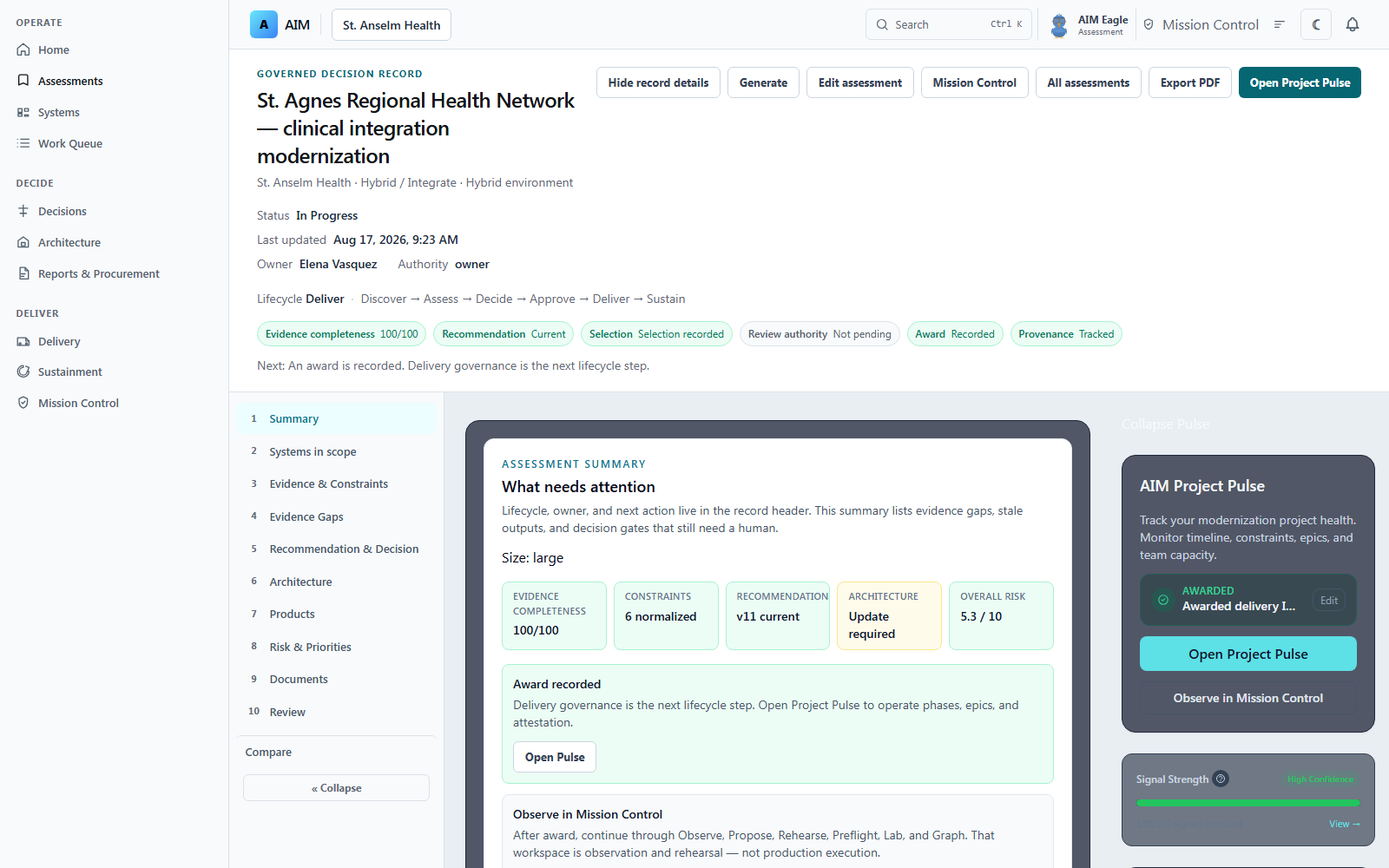
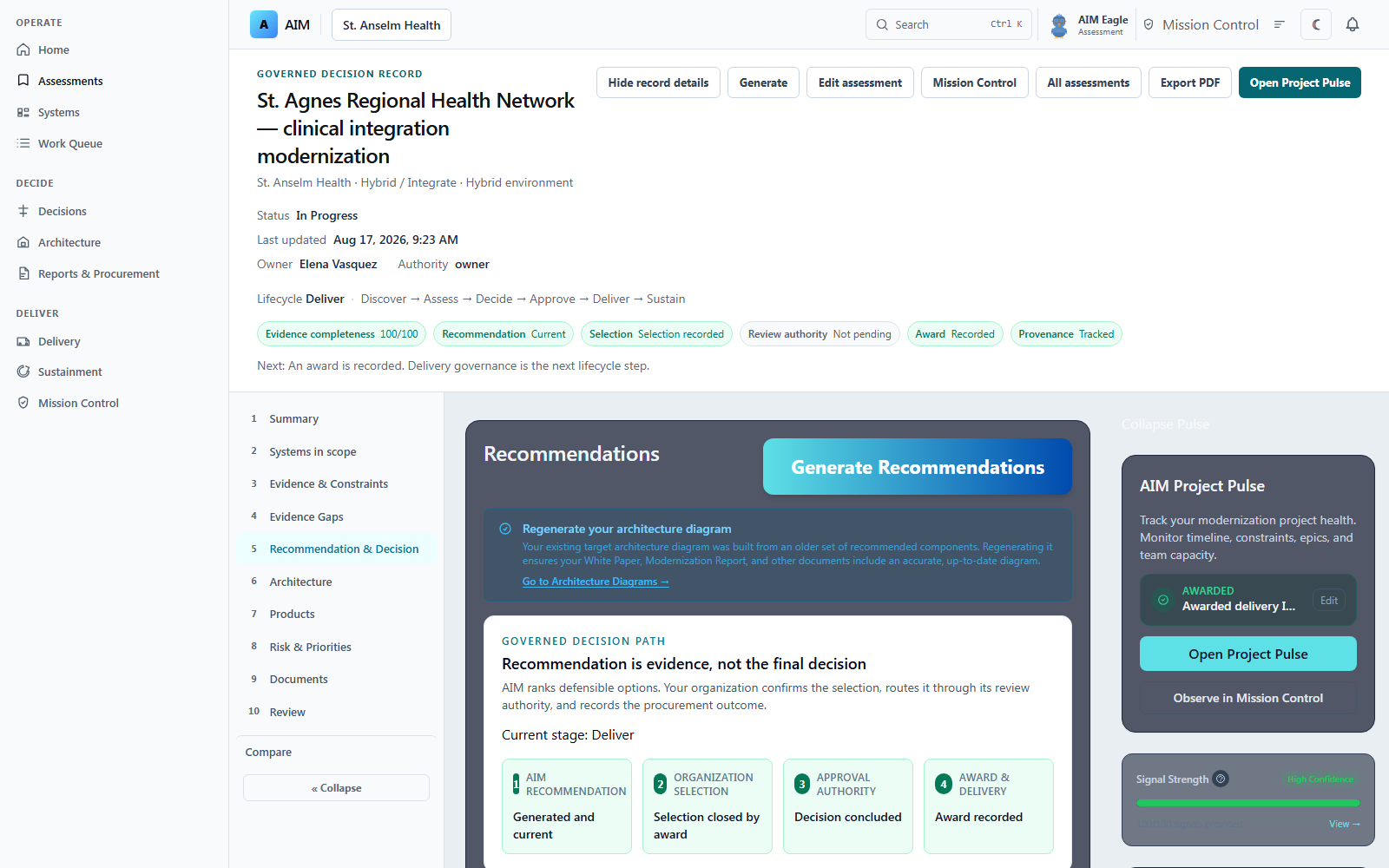
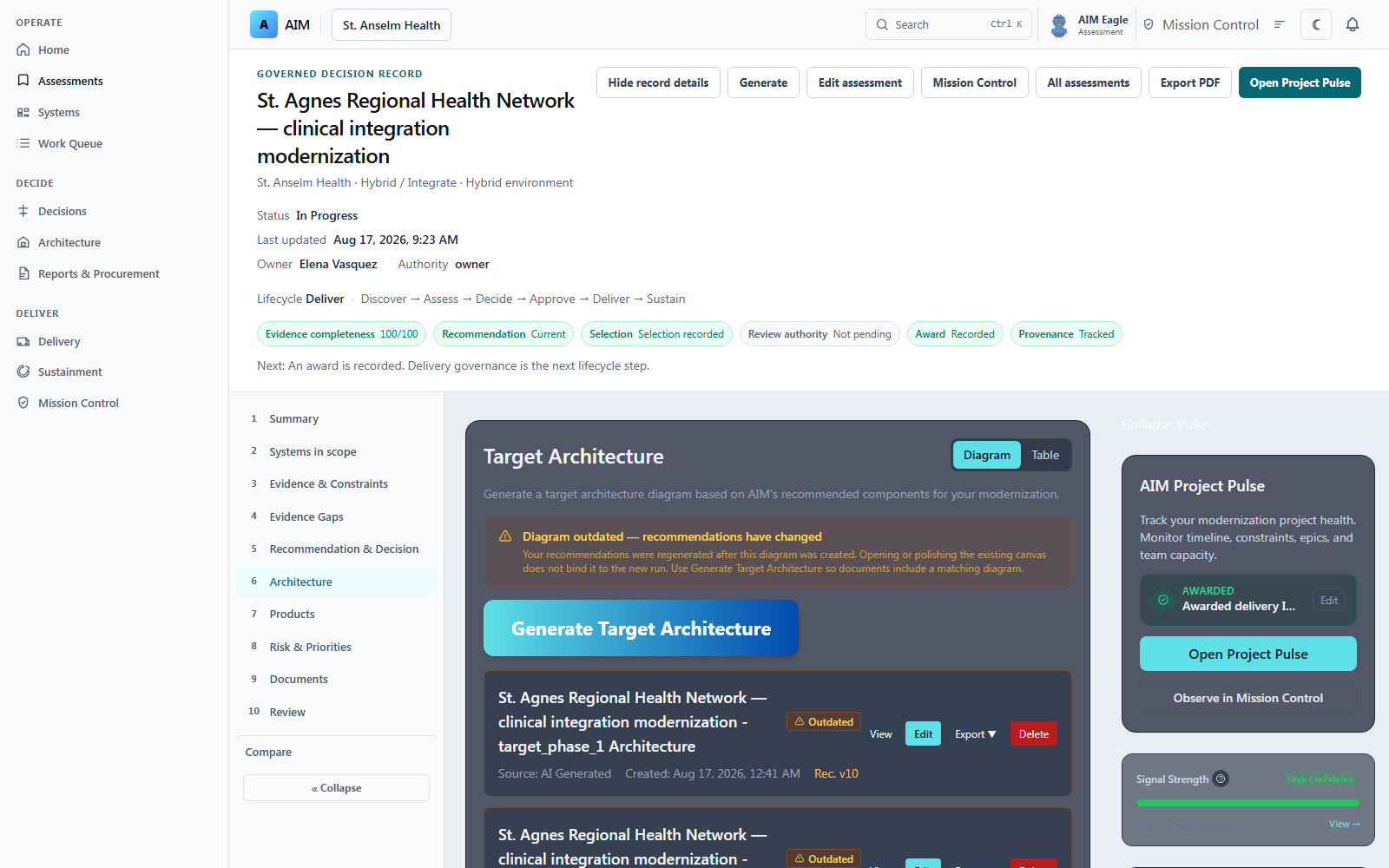
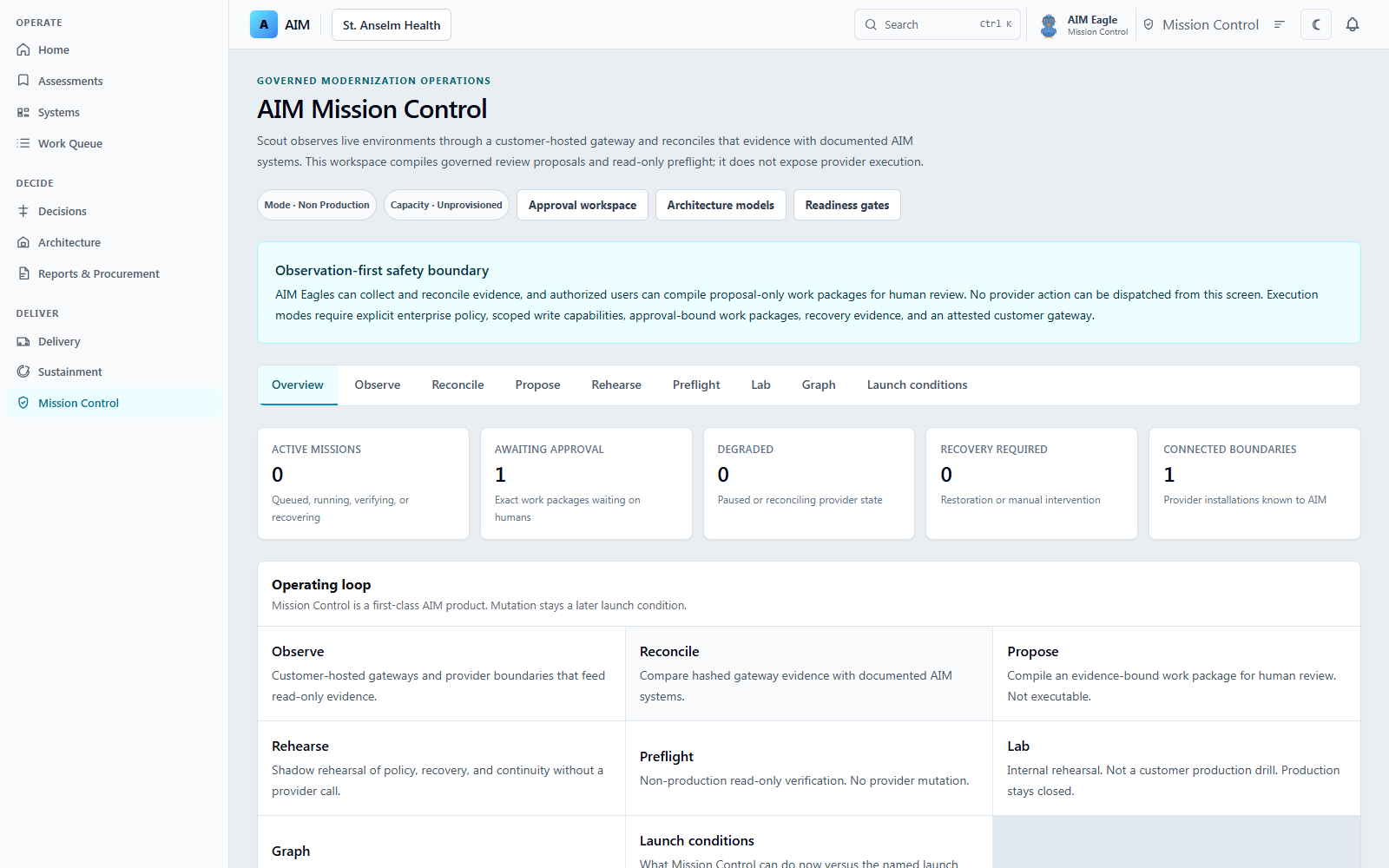
1. Start with a Guided Assessment
AIM begins with a structured intake that captures your environment in plain language. You answer questions — AIM normalizes and structures the rest.
Organization & environment
- City, county, agency, or business
- On-prem, cloud, or hybrid environment
- Size and scope of the effort
Systems & components
- Core systems (ERP, billing, public portals, EHR, mainframes, databases, firewalls, etc.)
- Critical infrastructure (network, storage, backup, identity)
Applications & vendors
- COTS products, SaaS platforms, custom apps
- Known vendor lock-in or proprietary dependencies
Integrations & data flows
- How data moves between systems
- Protocols and interfaces (APIs, file transfer, HL7, message buses, etc.)
Constraints & requirements
- Timelines, budgets, staffing limits
- Regulatory requirements (HIPAA, CJIS, PCI, FedRAMP, etc.)
- Uptime, security, data residency, and other technical requirements
Supply-chain policy
- Supply-chain risk tolerance and workload criticality
- Minimum supplier transparency and concentration tolerance
- Disruption limits and mandatory controls such as SBOM, VEX, signing, notification, remediation, and exit planning
Scope-conditional sub-questions automatically appear based on what you select — so you're only ever asked what's relevant to your project.
2. Constraint Normalizer (C-1, C-2, C-3…)
Free-text constraints are converted into normalized constraint records with stable IDs:
- C-1– Timeline
- C-2– Budget
- C-3– Regulatory
- C-4– Technical / SLA
- C-5– Data / Residency
- C-6– Security / Compliance
- C-7– Architecture / Dependency
- C-8+– Other
Each constraint is split into atomic statements, classified by type, and given a stable code. These codes appear in every recommendation and report so decision-makers can see exactly which constraints each recommendation honors.
3. Free-Text Signal Extraction
When you describe your constraints in free text, AIM automatically scans the language for structured signals — deterministically, at zero AI cost — and pre-fills relevant assessment fields without overwriting anything you've already provided.
Cloud providers
Detects Azure, AWS, GCP, Oracle Cloud, on-prem, or hybrid mentions
Regulatory scope
Identifies HIPAA, CJIS, FedRAMP, PCI-DSS, FERPA, SOX, GDPR, and more
Technology domains
Recognizes Identity, Data Platform, Integration, CMS, Cybersecurity, AI/ML, and others
Identity providers
Flags Active Directory, Okta, Entra ID, SAML/SSO, and similar indicators
Project timeline
Extracts month or year durations from natural language
Organization domain
Classifies federal, state/local, healthcare, education, financial, and non-profit contexts
Extracted signals are stored on the assessment and used to skip redundant follow-up questions. You can trigger re-extraction any time from the Smart Follow-Up tab.
4. Structured Context Builder
Behind the scenes, AIM assembles a structured context package — a curated, normalized representation of your situation that AI models are allowed to use. Raw survey answers are never passed directly to AI.
Project Identity & Archetype
Organization type, environment, size, scope. AIM automatically classifies projects across 10 modernization archetypes from assessment signals — no manual selection required.
Current State
Systems, applications, vendors, integrations, data flows, and known risks.
Scored Recommendations
RAO scores for candidate solutions, pre-computed from the catalog, with dimension breakdowns.
Architecture Patterns
Detected patterns (mainframe core, cloud-native, hub-and-spoke, API-driven) and applicable migration paths.
Safety Guardrails
Anti-hallucination boundaries that prevent AI from inventing vendors, regulations, or integrations not in your assessment.
This structured context — not your raw inputs — is what AIM's AI models work within. The package is built deterministically before any AI is invoked.
5. Assessment Confidence & Smart Follow-Up
AIM measures how complete your assessment data is and assigns a confidence tier that appears on every generated report. The more signals you provide, the more precise the recommendations and the stronger the report language.
Core fields provided. AIM shows the confidence of the estimate and the assumptions behind it. The report gets more precise as you add signals.
Most key signals present. Recommendations are well-scoped with moderate cost confidence.
Full signal set. RAO scoring and cost modeling are precise. Reports carry maximum authority.
Smart Follow-Up
After you submit an assessment, the Smart Follow-Up tab in your workspace generates a personalized list of up to 12 targeted questions — scoped to exactly what signals are still missing, prioritized by their confidence impact.
- ›Questions are ordered by how many confidence points each answer adds
- ›Signals auto-detected from your constraints text are pre-filled or skipped
- ›Scope-conditional questions only appear for your selected technology domains
- ›Answering any question immediately updates your signal score and confidence tier
- ›Reports can be regenerated at any time to reflect an improved confidence designation
6. RAO Engine (Ranking and Optimization)
AIM doesn't just “ask a model for ideas.” RAO is a scoring system that ranks modernization paths using your constraints as hard boundaries — not suggestions. It evaluates options across multiple dimensions:
- Cost – upfront + operating
- Maturity – stability and real-world adoption
- Security & compliance – fit against your regulatory profile
- Vendor lock-in risk – difficulty of future exit
- Operational complexity – skills, runbooks, and support needs
- Supply Chain Assurance – evidence-backed product assurance, applied only when a current score and explicit tolerance exist
- Strategic fit – alignment with constraints C-1, C-2, C-3, etc.
Each recommendation carries a RAO score and a dimension breakdown — so you can explain why a path is preferred, not just what the AI suggested.
Important: AIM outputs are designed to be reviewed, edited, and owned by your architects — not blindly accepted. The goal is a faster, clearer starting point, not a replacement for human judgment.
7. Risk & Integration Insight Engines
AIM analyzes your inputs to surface:
Risk patterns
- Single-vendor dependence on critical platforms
- Deprecated or end-of-life technologies
- Unencrypted or fragile data flows
- Gaps between requirements and current reality
- Product-specific vulnerability, supplier-advisory, provenance, evidence, and continuity gaps
Integration hot spots
- Choke points where many systems depend on a single integration
- Legacy protocols that will block modernization
- Candidate areas for API gateways, data hubs, or integration platforms
8. Anti-Hallucination Guardrails
AIM is deliberately strict about what it's allowed to say. The report and recommendation engines are explicitly instructed to:
- Use only facts present in the structured context
- Never invent vendors, technologies, integrations, or regulations
- Recommend named technologies only when supported by your inputs — and flag anything net-new
- Only mention HIPAA, CJIS, PCI, etc. if detected in your constraints or requirements
- Tie recommendations back to RAO scores and constraint codes
If the data isn't there, AIM prefers to say:
“This area requires more input before a confident recommendation can be made.”
That's by design. Your assessment confidence tier documents exactly how much data was provided and what was assumed.
9. Intelligence Layers
Beyond the core RAO engine, AIM applies proprietary intelligence layers when their required inputs are available. Deterministic layers enrich outputs without relying on AI guesswork:
- ›AI Readiness & Archetype Classification — When AI is in scope, AIM scores readiness and classifies the appropriate AI implementation approach.
- ›Modernization Focus Classification — Automatically infers the primary modernization archetype from assessment signals, adjusting RAO scoring weights downstream.
- ›FTE Estimation Engine — Produces a staffing range and duration estimate per archetype, broken out by delivery role.
- ›Labor Cost Intelligence — Computes delivery cost ranges across three models (market hiring, federal staffing, contractor) using authoritative federal rate data.
- ›Historical Procurement Benchmarking — Compares your project against real public-sector contract award data to surface comparable cost and duration ranges.
- ›Sustainment Cost Analysis — When enabled, extends the cost picture through long-term operational budgeting, staffing gap analysis, and 3- and 5-year TCO projections. Year 1 is shown on its own inside either horizon.
- ›Supply Chain Assurance — When product identity, current evidence, and organizational tolerance are available, calculates a versioned standing and contributes an evidence-gated seventh RAO dimension.
10. Outputs: What AIM Actually Delivers
From a single assessment, AIM can generate:
1. RAO-Backed Recommendations
- Ranked list of modernization options with clear tradeoffs
- Dimension scores and constraint references (e.g., “Addresses C-1, C-3, C-5”)
2. Modernization Brief (PDF)
- Executive summary, current state, and target architecture
- Priority recommendations table
- Risk, compliance, and tradeoff analysis
- Phased roadmap with quick wins vs. long-term moves
- Assumptions & Data Basis section — documents your confidence tier, what was provided, and what was estimated
3. Supporting Deliverables
- Compliance gap analysis against your declared regulatory scope
- TCO projection (3- or 5-year total; Year 1 shows startup cost, then staffing, licensing, and sustainment across the remaining years)
- Vendor Brief — a structured summary for prospective implementation partners
- RFP package with milestone payment terms and equivalency requirements
4. Modernization Strategy
AIM automatically selects a modernization strategy based on your archetype, environment type, vendor lock-in sensitivity, and system constraints:
| Strategy | Best For |
|---|---|
| INTEGRATE | Connect existing systems with new components while preserving current investments. |
| REPLACE | Retire outdated or unsupportable systems and deploy new solutions. |
| REPLATFORM | Move to a new platform with minimal code changes (“lift and reshape”). |
| LIFT & SHIFT | Fastest migration path — move with minimal changes. |
| MODERNIZE | Update existing systems in place with new technologies and patterns. |
| RETAIN | Keep systems as-is — meets current needs with no pressing drivers. |
| RETIRE | Sunset and decommission. Data migration and archival may be required. |
| MIXED | Multiple strategies apply across different components. |
11. Why AIM Is Different
Pre-Decision Layer
AIM operates upstream of workflow platforms, AI control towers, and execution runtimes. Those tools govern work once a platform has been chosen. AIM helps organizations decide what should be modernized, what should be avoided, what risks exist, and how to defend the decision before the platform commitment is made.
- Objective by design – AIM is not paid by vendors, marketplaces, or cloud providers.
- Constraint-driven – C-codes make your priorities explicit and traceable.
- Transparent – Recommendations and reports show why, not just what.
- Confidence-aware – Every report documents exactly what was provided and what was estimated.
- Segment-equal by design – Federal agencies, healthcare systems, state and local government, defense contractors, financial institutions, education, and commercial enterprises are all first-class contexts. The methodology is the same; only the output format adapts to the approval process.
Platform Independence
AIM is vendor-neutral in incentives and implementation. The Freedom Project does not accept vendor partnerships, referral fees, or kickbacks. Any qualified vendor can bid on work derived from AIM assessments.
When AIM names specific products, these represent a solution baseline derived from your assessment — not vendor preference. Vendors may propose alternatives only if they meet all requirements and include an equivalency matrix and impact summary.
Vendor neutrality includes recommending the discounted incumbent when it scores. A complete walk can conclude that the current stack — including a discounted government AI or cloud contract — is the better fit. AIM is not a bias against the incumbent.
12. Teams & Collaboration
AIM supports a multi-stakeholder model with six organization roles (Owner, Admin, Engineer, Program Analyst, Reviewer, Viewer) and a separate guest access system for external participants.
Organization Roles
Owners manage contract visibility, members, and audit logs. Admins manage day-to-day workspace access. Engineers run assessments and technical analysis. Program Analysts generate procurement documents and use the Document Translator. Reviewers approve and flag generated documents. Viewers can read and export existing reports but cannot generate new ones or modify anything.
Guest Collaborators
Assessment owners can invite external stakeholders (architects, vendors, agency partners) to a specific assessment via email OTP — no platform account required, no seat consumed. Guests cannot trigger AI pipelines or generate reports.
Audit Trail
Every collaborator action is logged — who accessed, when, and what changed. Owners and Admins can view an org-wide activity log and a per-assessment access log from the workspace Collaborators panel.
13. Product Catalog Query
Every assessment workspace includes a Product Catalog Query Widget that lets users investigate the technology catalog directly — without leaving the assessment.
Search & Explain
Search the catalog for any product. If it exists but was not among the top recommendations, request an AI-generated explanation using RAO scores, constraint fit, and competitor rankings. Explanations are cached for consistent repeat access.
Product Requests
If a product doesn't exist in the catalog, submit a request to The Freedom Project team. The form auto-populates your assessment and organization context. You're notified of the outcome.
User-Defined Constraints
Add any product as a user-defined constraint — whether it's existing infrastructure or a client preference outside AIM's evaluated scope. These appear in White Papers, RFPs, Executive Summaries, and Vendor Briefs with a clear user-defined designation.
14. Technology Catalog
AIM recommendations draw from a curated multi-category product catalog— including ERP, Identity & Access, Observability, Data Warehouse, ETL/Integration, and a full AI/ML suite covering Platforms, Generative AI, Data Science, MLOps, NLP, Computer Vision, AI Ethics, and AI Security. AI tools are compliance-filtered against CJIS, FedRAMP, HIPAA, and PCI based on your declared regulatory scope.
Vulnerability posture, certifications, data protection
FedRAMP, HIPAA, PCI-DSS, SOC 2 readiness
Total cost of ownership, pricing model transparency
Portability, migration friction, standards support
Skill requirements, maintenance burden, support quality
Ecosystem stability, community support, longevity
Product-specific evidence, confidence, coverage, failed gates, and intended-use tolerance when sufficient current evidence exists
Transparency Guarantee
Product rankings are determined solely by assessment-specific constraints and objective scoring dimensions. AIM does not accept vendor partnerships, referral fees, or placement fees. Each supply-chain finding follows the product that was reviewed, and buyers can see the evidence behind it.
Learn how Supply Chain Assurance works →15. Additional capabilities
The assessment, scoring, architecture, and document workflow above is AIM's core path. Two later capabilities extend that record. Neither is assumed in every workspace. Each appears when it is included in the organization agreement, and including one does not include the other.
Mission Control
Observes the live environment against documented systems, then packages reviewable work for designated human authority. Changing a live environment stays with the organization's own approval path.
AIM Mission Control →Agent Orchestration
Lets an organization's own AI start and advance AIM decision work — assessments, analysis, and drafts — while people still complete, award, attest, and vote.
Agent Orchestration →Ready to Get Started?
Create your first assessment and see how AIM works for your organization.