Governed delivery intelligence
Project Pulse
Project Understanding & Lifecycle Status Engine — a strategic delivery record that connects assessment evidence, contract milestones, risks, and implementation health without replacing the execution tools your teams already use.

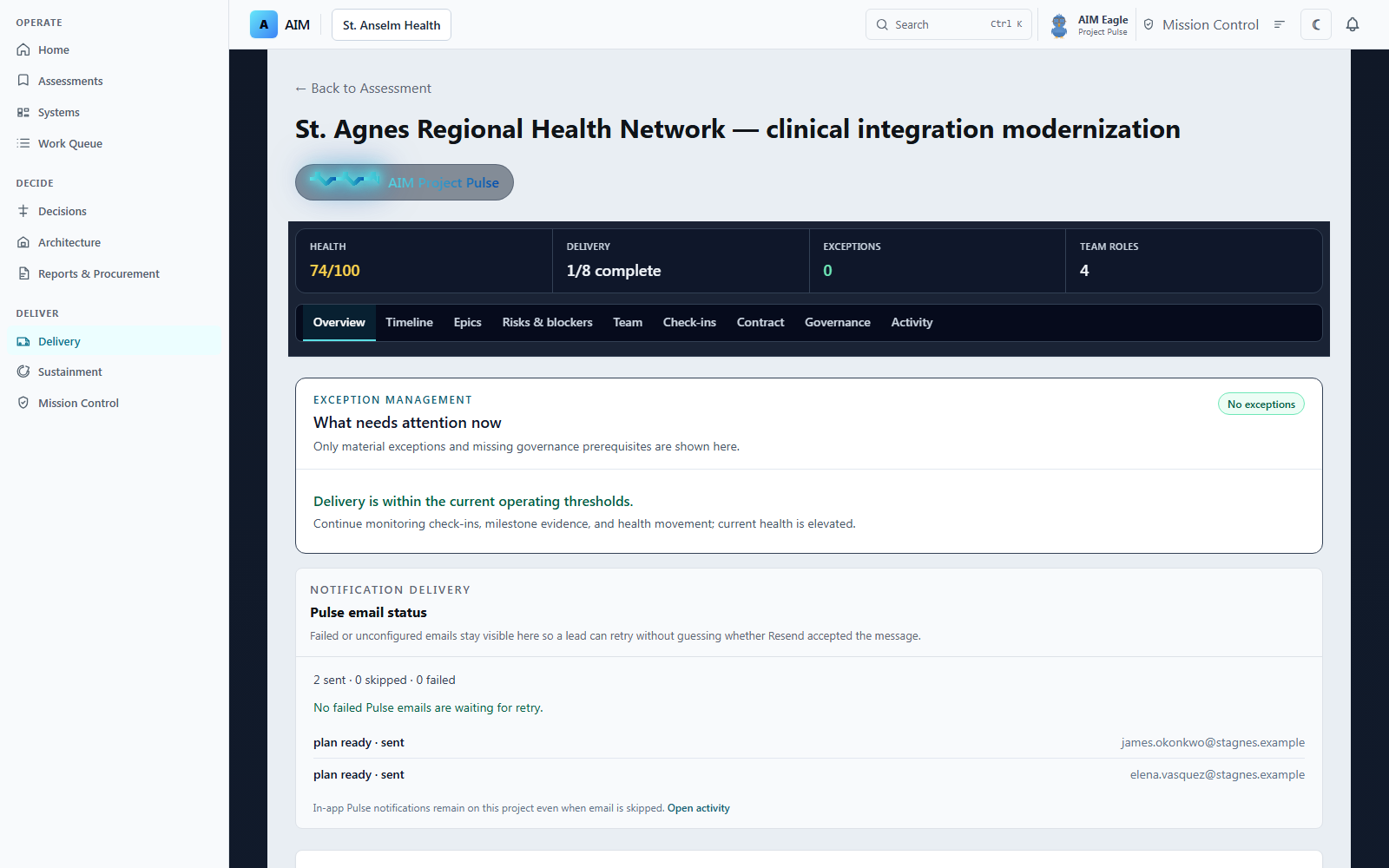
Anchored to a specific modernization initiative — one assessment, one award, one delivery program. Not a portfolio view, not a generic tracker.
Inherits the full assessment context — RAO scores, constraints (C-1, C-2…), recommendations, architecture, and staffing model — so it knows what the project is, not just what it’s called.
Spans the full post-award arc: epics, phases, attestations, check-ins, and milestone digests — from kickoff through delivery and outcome capture.
Continuously computed health score (0–100) across timeline, deliverables, constraint alignment, risk, and capacity. Status is derived, not self-reported.
Deterministic and rule-based. The score, the deployment order, and the digests are produced by AIM’s engine — not estimated, not LLM-generated, not editable by the team being measured.
What is PULSE?
PULSE is AIM's strategic project oversight layer that transforms your modernization recommendations into an actionable project timeline with real-time health monitoring.
Unlike traditional project management tools that focus on task-level tracking, PULSE provides executive-level visibility into modernization progress, risks, and milestones. It's designed for leadership, IT councils, and external stakeholders who need to understand project health at a glance—without diving into implementation details.
PULSE is NOT a Ticketing System
PULSE is intentionally strategic, not tactical. It doesn't replace Jira, Asana, or Azure DevOps for day-to-day task management. Instead, PULSE provides a high-level project heartbeat that leadership, councils, and external stakeholders can understand at a glance—without getting lost in tickets and day-to-day tasks.
Core Features
Health Score
A computed 0–100 score that reflects how the project is actually running — not just whether it finished. The score is deterministic and explained on the Pulse record; the internal penalty weights are proprietary and not published.
How closely actual progress tracks the expected pace. Being behind schedule or past the target date reduces this.
Overdue, blocked, or stale key deliverables reduce this. Items that stay current and complete do not.
Assessment constraints (C-1, C-2, …) should have epics mapped to them with active progress. Unmapped or unstarted constraints reduce this.
Blocked and at-risk epics reduce this. A project with no blocked or at-risk epics loses nothing here.
Compares estimated implementation load against team capacity signals. Overloaded teams, or a Pulse with no team roles defined, reduce this.
Status bands
On track. No significant concerns. Suitable for stakeholder reporting without caveats.
Minor issues detected. Monitor closely. Address timeline drift or constraint gaps before the next milestone.
Active problems require attention — blockers, overdue deliverables, or significant schedule drift.
Serious project failure indicators. Escalate. Multiple blockers, major overruns, or structural gaps in constraint coverage.
Why isn't a completed project scored 100?
The health score measures how the project ran, not just whether it finished. Even a fully delivered project carries the accumulated record of how it was executed — timeline drift at any point, how tightly constraints were mapped to epics, whether any items went stale mid-project, and how well team capacity was sized. A completed project scoring 81 means it was executed well with no critical risk indicators — a strong result that reads well in a program review or audit. A perfect 100 would require zero penalties across all five dimensions throughout the entire engagement.
Epics & Milestones
Major workstreams derived from AIM recommendations. Each epic tracks:
- Status — Current state of the epic (see below)
- Risk Score (0-10) — Structural risk this epic eliminates when completed
- Value Score (0-10) — How much it matters to outcomes
- Constraints — Dependencies tied to C-codes
Epic Status Definitions:
Designated Lead Workflow
Project Managers or designated leads own milestone sign-offs—keeping PULSE strategic, not tactical.
How it works:
- Team members update status externally (email, Slack, standups)
- Designated Lead synthesizes updates
- Lead attests to milestone completion in PULSE
- Attestation creates audit trail with name & timestamp
Public Embed Dashboard
Share a secure, read-only EKG-style timeline on external websites like city portals or council dashboards.
Embed token expires annually
The embed code contains a time-limited security token that expires after 365 days. If your embedded timeline stops displaying, the token has either expired or been regenerated. Return to the Public Pulse Dashboard in AIM, copy the updated embed code, and re-paste it on your website to restore the embed.
What Epic Scores Mean
Every epic carries computed signals derived from the same RAO dimension scores that ranked the recommended products. What drives your scores is explained on the Pulse record. The internal weighting formula is proprietary and is not published.
Risk Score (0–10)
How much structural risk this epic eliminates when completed
AIM scores recommended products across six core RAO dimensions. Supply Chain Assurance is included as a seventh dimension only when current product evidence and explicit organizational tolerance exist. The epic risk score leans on the dimensions most predictive of structural risk elimination — sourced from those stored scores, not estimated by category.
How secure the replacement product is. A highly secure replacement signals the existing system had significant security exposure.
Regulatory and GRC coverage of the new product. Strong compliance posture signals the existing system carried material regulatory exposure.
Lower lock-in on the new product means this epic reduces strategic risk — the organization is not simply trading one dependency for another.
Simpler replacements reduce execution risk. A high-complexity product introduces operational uncertainty that can offset some of the risk-reduction benefit.
Value Score (0–10)
How much operational business value this epic delivers when completed
The value score uses the same persisted RAO dimensions, emphasizing those most predictive of business value delivered. That is why two epics with similar risk scores can have very different value scores — a security epic and an ERP epic serve different organizational purposes.
Proven products deliver reliable, measurable value. An immature product may be technically strong but delays value realization.
Cost-efficient products deliver financial value through lower total cost of ownership, reduced licensing overhead, and better resource utilization.
Lower complexity means faster time-to-value. A complex product can delay realizing the business benefit even when the benefit exists on paper.
Compliance coverage removes regulatory friction that can delay or block value delivery. It is treated as a value enabler, not the primary value driver.
Internal effort signal
Used by AIM to understand implementation demand — not shown on epic cards
Pulse is a strategic oversight record, not a Scrum or Kanban planning board. AIM keeps an internal implementation-demand signal so delivery history can inform later analysis. That signal is not operator-assigned story points and is not displayed on epic cards or dashboards.
The specific calibration of that internal signal — including category baselines and any risk or complexity adjustments — is proprietary to The Freedom Project and is not published. As AIM accumulates delivery data through completed epics, the signal improves automatically.
The EKG Timeline
PULSE displays project progress as an EKG-style heartbeat that pulses and glows as milestones complete.
Getting Started with PULSE
Create an Assessment
Start by creating an AIM assessment for your modernization project. Add systems, constraints, and risks.
Generate Recommendations
Let AIM analyze your environment and produce RAO-scored modernization recommendations.
Launch PULSE
Click the PULSE badge on your assessment to activate project tracking. Recommendations become epics.
Ready to monitor your modernization?
Bring AIM into your organization to connect assessment evidence with governed delivery visibility.