Architectural Insight for Modernization
How AIM supports governed modernization
See how AIM maps organizational context, evaluates constraints, produces defensible decisions, and supports delivery under an enterprise agreement.

New to AIM? Start with the problem it's built to solve.
See the documented pattern behind government and healthcare IT failures — and what it costs.
Where AIM fits
AIM is the pre-decision intelligence layer for technology modernization.
Workflow platforms, AI control towers, and execution runtimes help organizations run the work once a platform has been chosen. AIM operates upstream of all of that — helping organizations understand what their environment actually needs, what the lifecycle cost will be, what the risks are, and how to defend the decision before the contract is signed.
By the time execution-layer governance kicks in, the procurement decision is already made and the lock-in is already paid for. AIM is in the window where the money is actually being committed.
One authoritative methodology
See exactly how AIM works
Explore AIM's complete evidence-to-decision workflow, technical controls, and the St. Agnes healthcare modernization walkthrough in one place.
Example outputs (fictional)
See what AIM produces from a sample assessment. All examples shown are from a fictional organization.
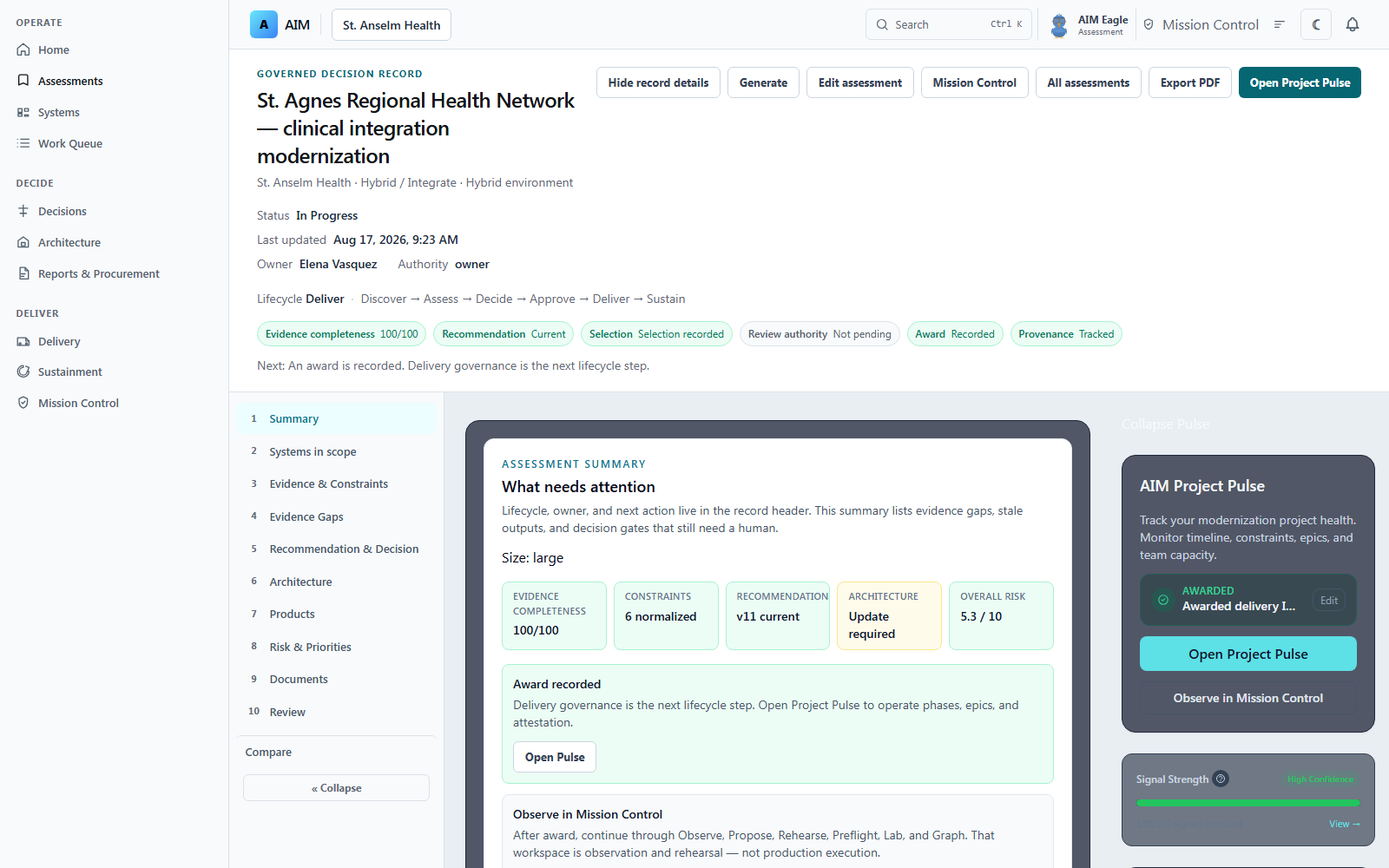
Assessment workspace
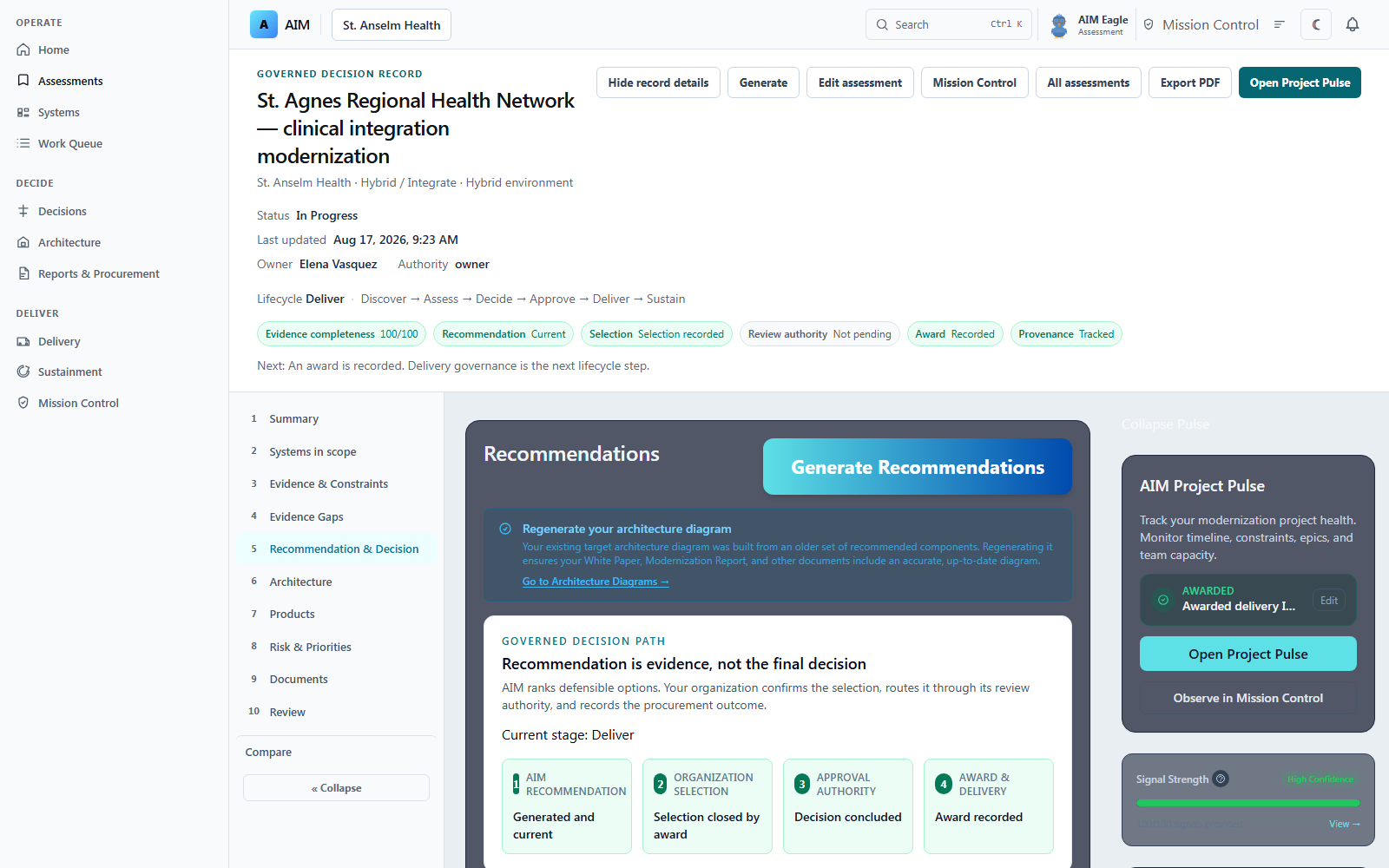
Recommendation & decision
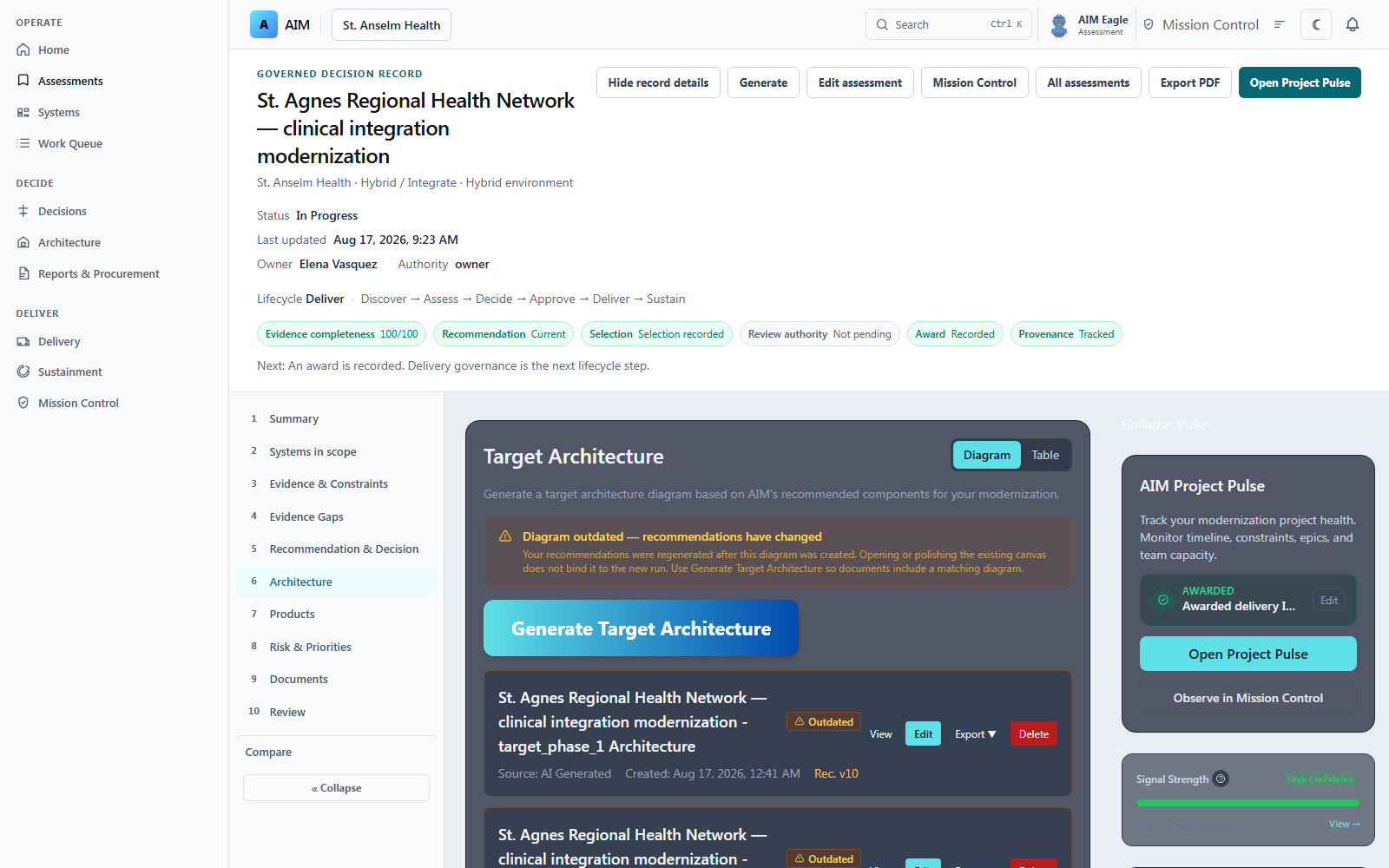
Target architecture
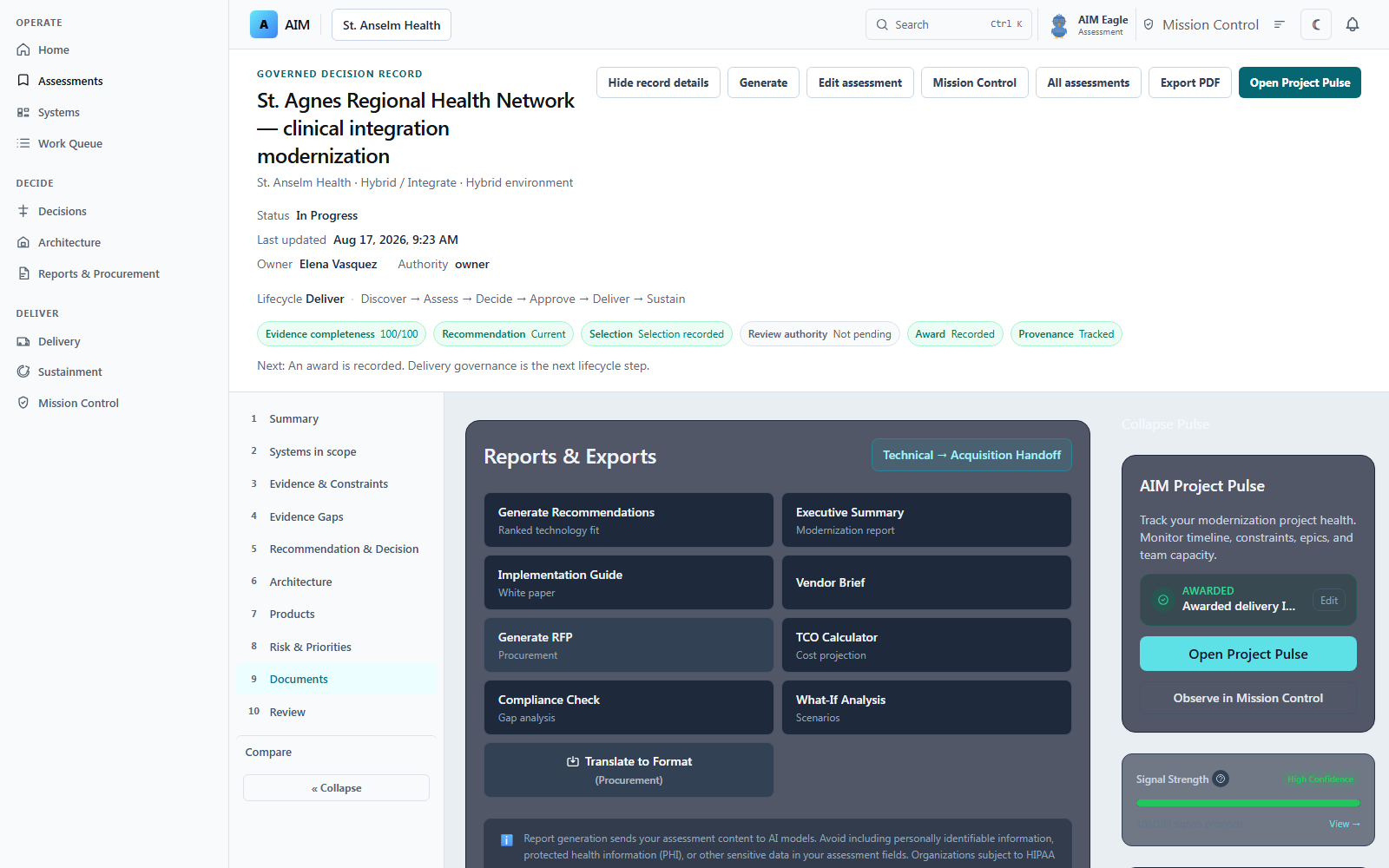
Documents & procurement
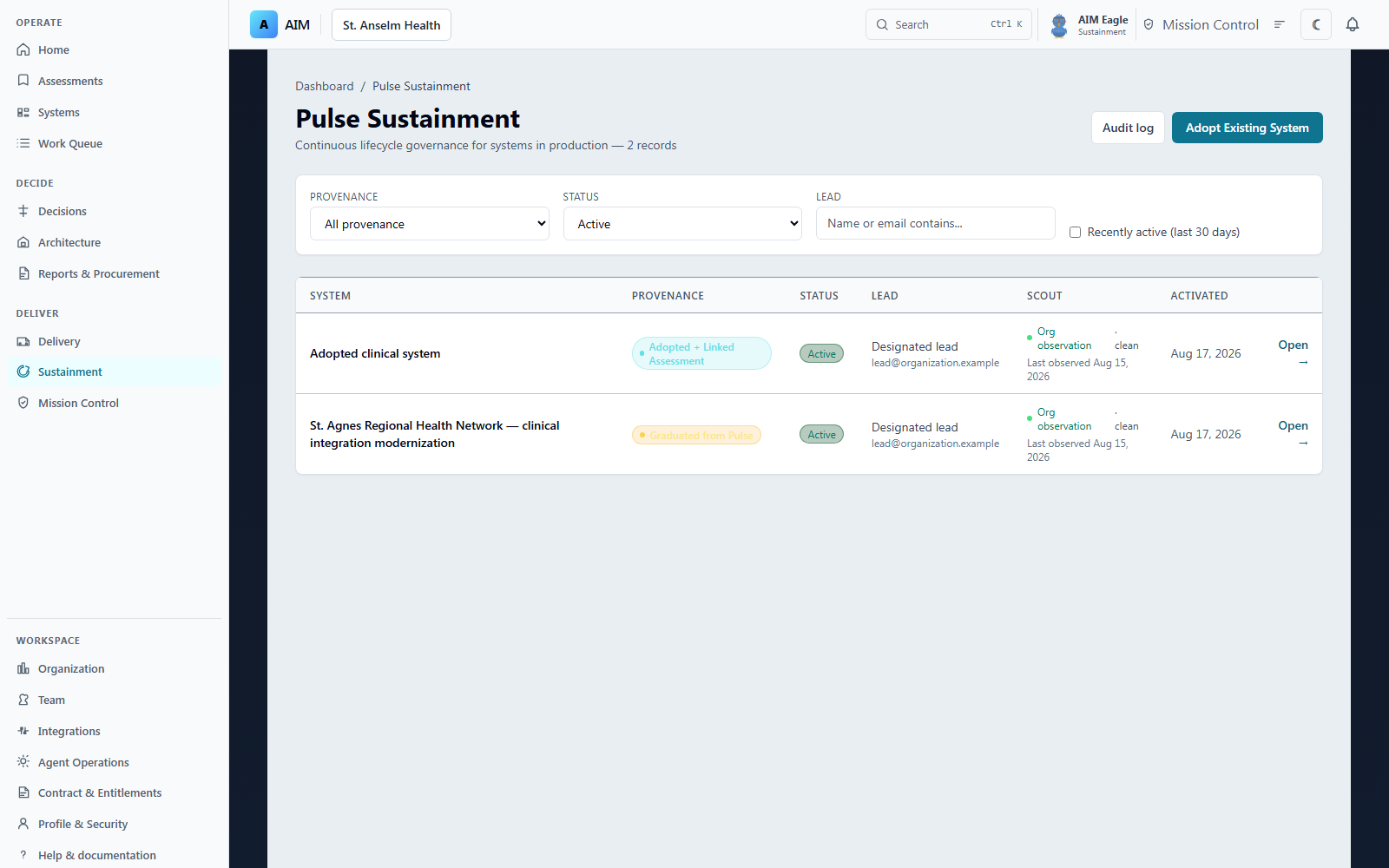
Pulse Sustainment
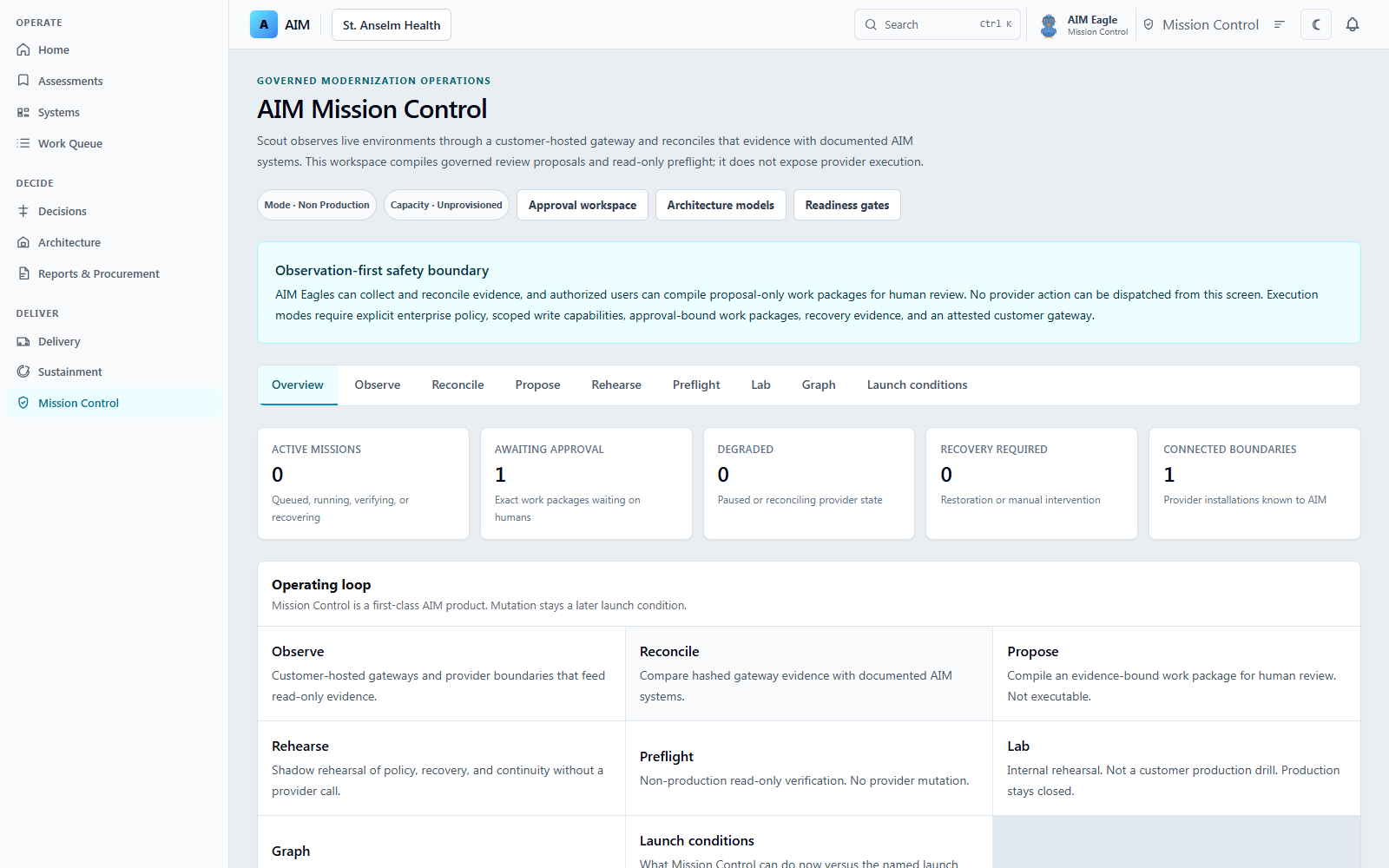
Mission Control
Sample modernization white paper (fictional)
Scroll through an AIM-generated deliverable in-page. This is the type of procurement-ready document you receive with every assessment.
Fictional example. Outputs depend on inputs and constraints.
Sample RFP document (fictional)
Browse an AIM-generated RFP in-page. This is the type of procurement-ready document you can export with every assessment.
Fictional example. Outputs depend on inputs and constraints.
Explore Our Methodology
Dive deeper into how AIM works, how organizational constraints shape rankings, and how product assurance evidence is evaluated.
How AIM Works
Overview of the AIM platform, assessment process, and recommendation engine.
One Complete Decision
The sit-through tape: evidence, alternatives, 3- and 5-year affordability, approval, then Pulse and Pulse Sustainment.
Compared with Cheap AI
Why discounted government AI and governed-execution workflow tools are not a substitute for the pre-decision walk.
Getting Started
A public walkthrough from invitation through the first assessment and delivery record.
AIM Mission Control
Scout observation, human review packages, and no-change rehearsals in the customer environment — without giving AIM change authority. An additional capability when included in the organization agreement.
Agent Orchestration
How an organization’s own AI can start and advance AIM decision work while people still finalize irreversible steps. An additional capability, separate from Mission Control.
Scoring Methodology
How AIM calculates, curates, and audits RAO dimension scores for technology recommendations.
Constraints & RAO
How constraints influence scoring and how the RAO engine prioritizes recommendations.
Supply Chain Assurance
How AIM evaluates product evidence, uncertainty, and organizational risk tolerance across software, hardware, cloud, SaaS, and AI.
Decision Transparency
How AIM ensures traceable, auditable, and defensible technology recommendations.
Cost Estimate Confidence
How AIM sources, validates, and reports confidence for hardware/cloud/SaaS cost estimates.
AI Approach
How AIM uses AI responsibly for document generation while keeping humans in control.
Project Pulse
Real-time project tracking, milestone management, and delivery monitoring.
Pulse Sustainment Mode
The post-implementation lifecycle layer — change requests, board votes, configuration drift, compliance events, and procurement actions, all tied back to the as-built baseline when enabled by the organization agreement.
Layer 1 Infrastructure
Physical infrastructure cost estimation methodology for cabling, pathways, and labor.
Lifecycle Affordability
Why knowing what a system costs to build is not the same as knowing what it costs to own — and how AIM surfaces the gap before the contract is signed.
Data & Privacy
What data AIM collects, how it is used, and how long it is retained — including our NIST-aligned audit log retention schedule.
AI Audit & Decision Provenance
How AIM cryptographically seals every AI-assisted recommendation and lets any auditor independently verify it — no account required. Patent pending.
Accessibility
Our commitment to WCAG 2.2 AA and Section 508 conformance, how each platform area is covered, and how to report a barrier.
Evaluation workspaces — Data Handling & Retention
How AIM handles data when an organization is provisioned for evaluation.
What is collected
Evaluation happens inside a provisioned organization workspace. AIM collects the same assessment and operational records it would for a contracted customer, under that organization's identity, MFA, and audit trail. Public anonymous Guest Mode is closed.
How long it is retained
Rate limit records
24 hours
IP address, browser fingerprint, and device token used only to enforce the 3-per-day usage limit. Deleted on a rolling basis.
Guest session data
30 days
Form responses and the generated report are retained for up to 30 days for security, support, and an explicitly authorized transfer into a provisioned organization workspace. Automatically purged after expiration.
What we do not do with your data
- We do not sell or share evaluation-workspace data with any third party.
- We do not use customer or evaluation data to train AI models.
- We do not use leftover anonymous guest rows for marketing.
- Public Guest Mode is closed; evaluation requires a separately provisioned organization workspace.
Security
Guest session data is stored in the same encrypted, access-controlled Supabase infrastructure that protects all AIM data. Row-level security policies restrict access to service-role API routes only — no client can query your session directly. Data is encrypted in transit (TLS) and at rest.
Request a provisioned evaluation workspace
Evaluation access is invited, time-bounded, and uses the same AIM product as a contracted organization. Request it from Enterprise Access or [email protected]. There is no public self-serve trial.
Account & Organization Data — Retention Policy
How AIM handles assessment data, organization records, and contract history while a workspace is active or after it closes.
While your account is active
All assessment data, architecture recommendations, reports, and organization records are retained while your organization workspace is active. Nothing is automatically deleted while your contract is in good standing. Authorized users can archive or remove assessments from within the platform.
Retention periods by data type
Assessments & reports
90 days after cancellation
Assessment content, architecture outputs, and generated reports are retained for 90 days after organization closure unless the agreement or applicable law specifies another period.
Contract & financial records
7 years
Agreements, invoice history, and payment records are retained for the legally or contractually required period outside the product workspace.
User accounts & profiles
90 days after cancellation
User login credentials and profile data are removed 90 days after the organization closes, unless the user has access to another active organization.
Audit & activity logs
3 years
Platform audit logs (logins, exports, attestations) are retained for 3 years for security and compliance defensibility.
What happens when an organization closes its workspace
Access is locked immediately
Access is suspended as soon as the closure or deletion request is recorded. Existing assessment content is preserved for the retention window.
90-day retention window begins
A 90-day clock starts from the organization closure date. An authorized contract administrator may request restoration during this window.
Permanent purge at day 90
Assessment content and personal information are permanently deleted. The organization record is anonymized and required contract or financial records are retained outside the workspace.
Requesting early deletion
Organization admins may submit an explicit account deletion request at any time from their account settings. This triggers the same 90-day window and gives you the opportunity to cancel the request before data is permanently removed. Once purge processing begins it cannot be reversed. For immediate deletion requests, contact [email protected].
What we do not do with your data
- We do not sell or share your assessment data or organization records with any third party.
- We do not use your assessment content to train AI models.
- We do not retain personal information beyond the schedules above.
- Contract and entitlement metadata is available only to authorized administrators and operational personnel.
Need to restore a closed workspace?
If an authorized restoration is approved before the 90-day window closes, the workspace and its assessments, reports, and organization data can be returned to active status without re-entry.
Platform Concepts
Understand the core building blocks available through an AIM organization deployment.
Assessments
An assessment is a structured modernization project inside AIM. You describe your current environment, constraints, and goals—then AIM scores technologies, generates architecture diagrams, and produces procurement-ready exports. Assessment capacity is governed by your organization agreement.
Project Pulse
Project Pulse tracks the health of your modernization after the assessment is complete. It covers milestones, epics, team capacity, and delivery status—giving leadership a real-time view of whether projects are on track when enabled for the organization.
Pulse Sustainment Mode
Pulse Sustainment Mode (PSM) picks up where Project Pulse leaves off. When the implementation is complete, PSM freezes the original Pulse as the as-built baseline and starts the operational record—change requests, board votes, configuration drift, compliance events, and procurement actions.Learn more →
Mission Control
Mission Control observes the live environment against the documented AIM record and packages reviewable work. Production change stays separately gated. It appears when included in the organization agreement. Learn more →
Agent Orchestration
Agent Orchestration lets an organization's own AI start and advance AIM decision work. People still complete, award, attest, and vote. It is separate from Mission Control and appears when included in the organization agreement. Learn more →
Ready to Get Started?
AIM is provisioned through enterprise consultation, contracting, and administrator-controlled onboarding.