Undocumented resources
Observed live, but not in documented AIM systems, architecture, or Pulse Sustainment records.
Governed modernization operations
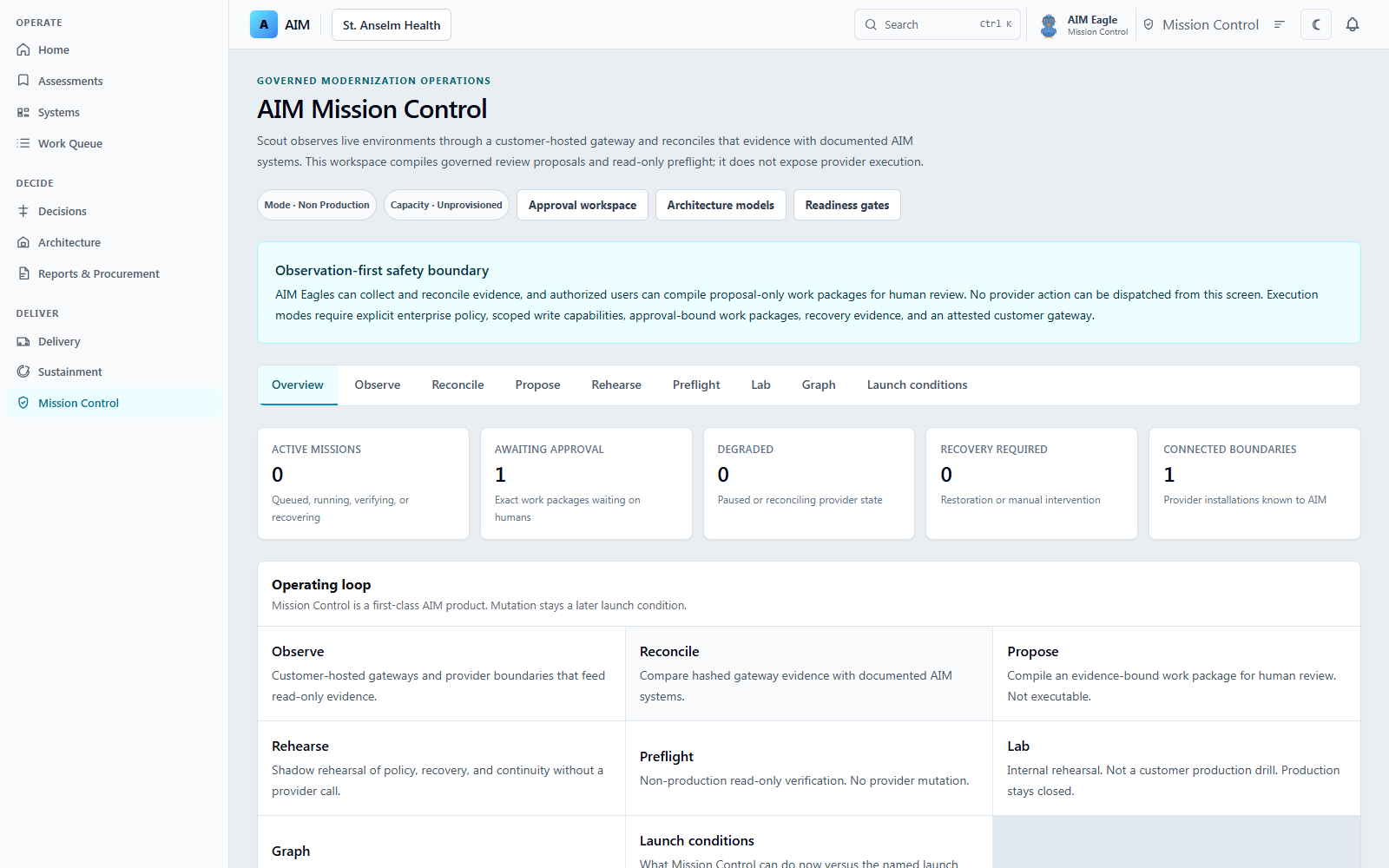
A production workspace for turning current environment evidence into reviewable modernization missions — with human authority, risk visibility, verification, and recovery posture at every step. Scout is the read-only observation layer inside this workspace. Changing a live environment stays with the organization's own approval path.

The operating concept
AIM already helps organizations understand environments, compare options, govern architecture, and preserve decision evidence. Mission Control extends that record toward supervised execution: showing what is planned, who approved it, where work stands, what changed, and whether the result was independently verified.
It is not an autonomous administrator and it does not replace customer change control. Consequential work remains bounded by organization policy, designated authority, explicit approvals, and customer-controlled access. Mission Control is an additional AIM capability. It appears when it is included in the organization agreement. The core assessment workflow does not depend on it.
This is not Agent Orchestration. Orchestration is how an organization's AI works inside AIM's decision workflow. Mission Control is how AIM observes and later governs work in the customer's environment, bound to that organization's assessment and approvals.
Scout observation
Scout is Mission Control’s read-only observation layer. A customer-hosted, outbound-only gateway collects current environment evidence. AIM stores hashed, normalized labels and reconciles them with documented systems, architecture, and Pulse Sustainment records. Cloud credentials stay in the customer environment. Scout’s job is the current picture. Changing a live environment stays with the organization’s own approval path.
Scout comes first so the current picture, the evidence, and a named person stay in front of any later change.
Observed live, but not in documented AIM systems, architecture, or Pulse Sustainment records.
Recorded in AIM and absent from a complete current observation graph.
An observed target is currently reported as warning or critical. Scout records evidence only.
A previously observed resource is marked missing after a later complete inventory.
Scout has no AIM-hosted provider write path, no stored cloud secret, and no mutation command. Observation is performed by a customer-hosted, outbound-only gateway. Findings are generated by deterministic comparison of hashed labels against the documented baseline — there is no model inference in the discovery or delta analysis path.
A Scout finding can become a Pulse Sustainment change request with the observation context attached. The Change Control Board still votes. Scout records the evidence. Changing a live environment stays with the organization's own approval path.
The organizations AIM serves cannot treat a wrong autonomous action as a hotfix. Federal ATO and FISMA incident reporting, HIPAA breach notification, CMMC and DFARS exposure, and SOX control deficiencies are not reversible in a blog post. Scout keeps observation, evidence, and human authority in front of any later execution capability.
Scout does not replace dedicated cloud security posture platforms. If an organization already runs a continuous scanner, Scout adds governance continuity: live hashed labels compared with this organization's documented AIM record, then routed into the same change workflow as every other operational decision.
Governed rehearsal
Authorized teams can run an approved non-production package through queueing, step coordination, verification, uncertainty, and recovery states in a shadow rehearsal. Teams can deliberately exercise interruption and mismatch scenarios, observe how AIM pauses and recovers, and review the resulting audit trail. The rehearsal does not send a provider command or change a connected environment.
Read-only preflight operations
Mission Control can validate a short-lived, signed preflight envelope with an assigned customer-hosted gateway, confirm the exact approved package was received, and perform one narrowly scoped non-production boundary read. The result is returned as signed evidence without exposing provider identifiers. A live operations view shows whether work is waiting, claimed, verified unchanged, failed closed, or reconciling. Attention conditions can be assigned to a named human owner and tracked through acknowledgment, recovery review, and verified closure. When the evidence is clean, independent risk and executive authorities can certify the record for human review. The readiness package names the action, verification, recovery, maintenance, supply-chain, and capacity conditions the organization will use. A governed catalog describes each proposed provider action and the controls it requires. If the gateway or network is interrupted, durable checkpoints keep uncertain work from being repeated and AIM moves the outcome into reconciliation. Changing a live environment stays with the organization's own approval path.
Artifact authenticity and authorization are different stories. A verified signature means the envelope is the one AIM issued. Authorization to run it in production is a separate decision, recorded by the customer's designated authorities. Observe, propose, rehearse, and signed preflight are the live Mission Control path.
In production
Mission Control can turn selected, current environment evidence into an ordered proposal with affected areas, computed risk, policy results, approval responsibilities, verification criteria, and a safe no-change recovery posture. Each proposal is versioned so reviewers can see exactly what they are considering, and designated authorities can record a rationale against that exact version. Compilation and human approval do not create provider commands, reserve execution capacity, or change a customer environment.
Governed lifecycle
01
Establish a current, evidence-backed view of systems, dependencies, delivery state, and constraints.
02
Compile a bounded modernization mission with expected outcomes, affected areas, risk, and verification criteria.
03
Route the exact mission to the people accountable for architecture, security, procurement, and executive direction.
04
Schedule approved work within organization policy, operational capacity, and environment-specific controls.
05
Compare actual results with the approved intent and collect evidence before work is accepted as complete.
06
Preserve the decision record, monitor outcomes, and surface drift or follow-on work.
Multi-user operations
Mission Control is designed for multiple authorized users and AIM Eagles working at the same time. Organization policies coordinate competing work, prevent conflicting activity, maintain fair capacity, and make operational demand visible as contracted capacity.
Continuity
If an Eagle, connection, or provider becomes unavailable, AIM is designed to stop conflicting activity, reconcile the real environment, determine what actually occurred, and require verification before resuming, restoring, or escalating to a human recovery path.
Enterprise ecosystem roadmap
Connections will be provisioned separately by environment and capability. Availability will depend on enterprise agreement, security review, provider support, and organization policy.
GitHub, GitLab, and Azure DevOps
Amazon Web Services, Microsoft Azure, Google Cloud, and Oracle Cloud Infrastructure
Jira and ServiceNow
Kubernetes and governed GitOps workflows
Related reading
The operational governance layer Scout findings can enter as change requests.
How AIM preserves an auditable record from observation through approval and outcome.
How customer-hosted gateway evidence is collected, used, and retained.
How an organization’s AI can operate AIM decision work while people still sign.
Where AIM uses deterministic engines first, including Scout reconciliation.
What customers can expect