Governed environment observation
Scout Agent
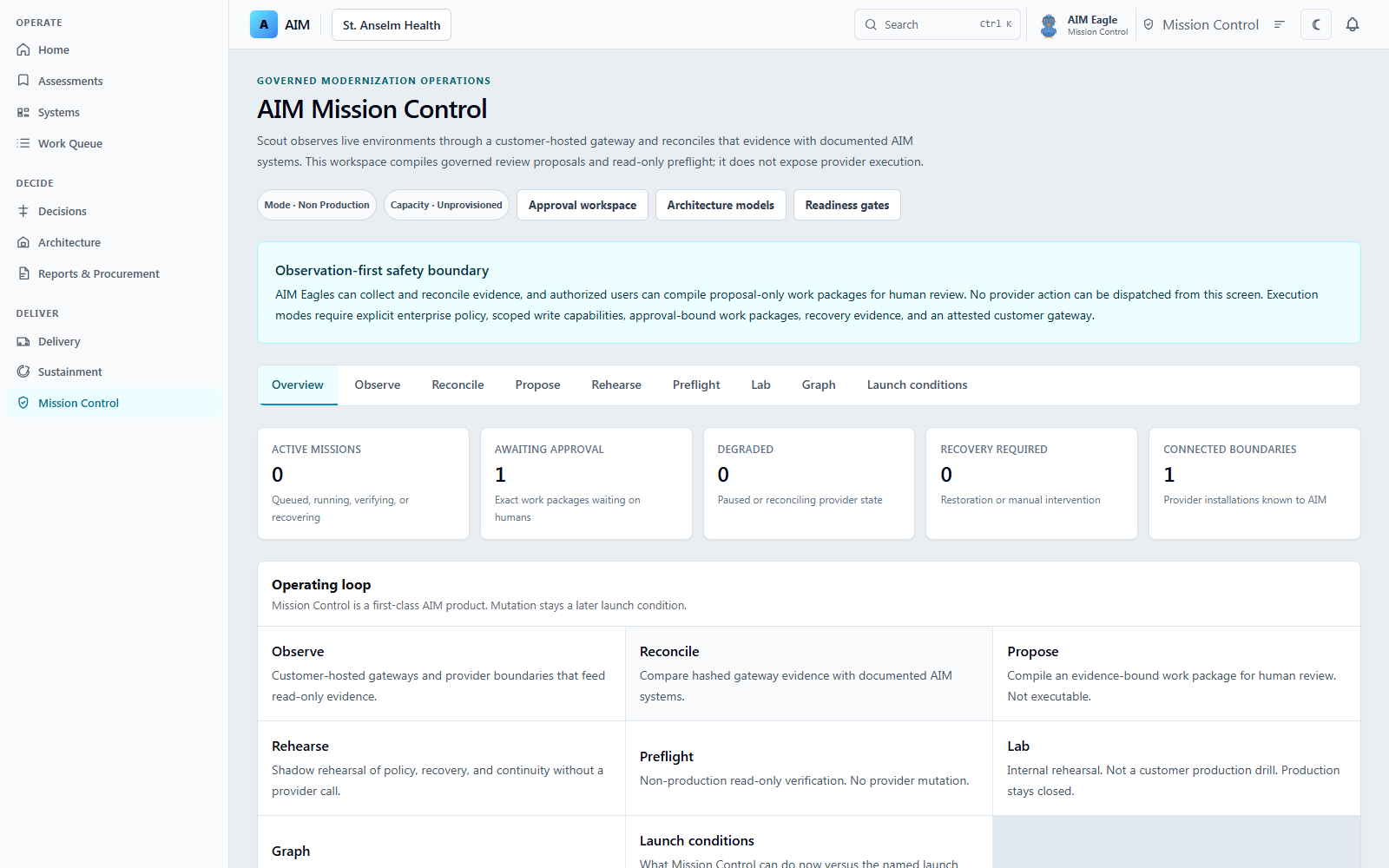
The read-only observation layer of AIM Mission Control. A customer-hosted gateway supplies hashed live evidence; Scout reconciles it with documented systems. Scout cannot patch, install, or deploy.

“An agent that acts before it can reliably observe is dangerous.”
Most of the agentic AI conversation in 2026 is about action — autonomous agents that fix, deploy, remediate, and configure on your behalf. Very little of it is about what has to come first: a reliable, verified picture of what is actually running in your environment. Scout is that picture. It is the foundation that every autonomous action capability AIM builds in the future will stand on — and without it, “agentic AI” is just an agent acting on bad assumptions.
What Scout does
Scout observes your cloud account through a customer-hosted Mission Control gateway. Credentials stay in the customer environment. AIM stores only hashed, normalized evidence and reconciles that evidence against the documented baseline in your Pulse Sustainment Mode record.
What Scout surfaces from each observation
Why “move fast and break things” does not apply here
That ethos was coined for consumer social media apps in 2008. The consequence of breaking things at a startup building a newsfeed was: some users had a bad day, you pushed a fix, you iterated. Low stakes. Reversible. Nobody got hurt.
The organizations AIM serves operate under a fundamentally different accountability structure. Here is what “breaking things” looks like for them when an autonomous agent acts without a verified observation layer:
Scenario: An autonomous agent misconfigures a security group in a FedRAMP-authorized system.
Consequence: Potential ATO violation. FISMA incident. Mandatory breach reporting to CISA within 72 hours. Possible suspension of the authorization to operate — which means the system goes offline until the agency completes a full re-assessment.
Scenario: An agent auto-scales a database cluster and corrupts a table in the wrong account.
Consequence: PHI exposed. OCR investigation under HIPAA. Breach notification required to every affected patient within 60 days. Fines up to $1.9M per violation category per year. Potential class action.
Scenario: An agent deletes what it classifies as an inactive resource that is actually a backup node for a classified pipeline.
Consequence: CMMC Level 2 or 3 incident. Potential DFARS clause violation (252.204-7012). Contract at risk. Prime contractor liability if the failure cascades downstream to a DoD program.
Scenario: An agent modifies a network ACL to remediate a finding — that ACL was there for SOX audit isolation.
Consequence: Material control deficiency. SEC disclosure obligation within 4 business days for public companies. Regulatory examination exposure. Potential restatement of internal controls.
None of these organizations can apologize in a blog post and push a hotfix. The blast radius of a wrong autonomous action in a regulated cloud environment is asymmetric and often irreversible. You can always choose to act later. You cannot un-expose patient data, un-file an SEC disclosure, or un-trigger a DoD program investigation.
The regulatory environment has also moved in this direction. High-risk AI systems must maintain logs enabling post-hoc auditability, with traceability and technical documentation requirements that continue to expand — AIM's architecture was designed with that direction in mind. SEC cybersecurity disclosure rules require material incident reporting. State privacy laws create individual liability for data exposure. HIPAA, CMMC, FedRAMP, FISMA — every compliance framework AIM's customers operate under creates legal accountability for what autonomous AI does in their environment. “The agent acted on its own” is not a defense. It is an aggravating factor.
What makes Scout different from “agentic AI” products
1Deterministic findings — no LLM in the analysis pipeline
Every Scout finding is generated by rule-based code that compares hashed gateway evidence against your documented baseline. There is no Claude call, no model inference, and no probabilistic reasoning in the discovery or delta analysis path. An undocumented resource is flagged because the observed label does not match a documented AIM system name or an exact vendor label — not because a model thought it sounded risky. Findings are reproducible, auditable, and explainable without qualification.
2Read-only by architecture, not by policy
Most autonomous agent products are built to act and can be configured to read-only mode. Scout is built read-only from the ground up — there is no AIM-hosted provider write path, no stored cloud secret, and no mutation command in Scout. Observation is performed by a customer-hosted, outbound-only Mission Control gateway. This is not a guardrail on top of an action-capable Scout. It is a deliberate architectural choice about what this phase of the roadmap is for.
3Scoped to your organization's documented baseline
Generic cloud security scanners apply generic rules to generic cloud estates. An “undocumented resource” finding in Scout means something specific: this resource is running in your account and it is not in the system inventory your team documented in AIM. The comparison is between your live environment and your own record — not a benchmark, not a compliance template, not what some other organization documented. Scout knows your architecture because AIM built it.
4Findings connect to a governed workflow, not a dashboard
Most cloud security tools produce findings that land in a vendor dashboard and require a separate ticketing process to act on. A Scout finding can become a PSM Change Request with one click. That CR goes through your Change Control Board, gets voted on by the people you designated, gets attested when the change is implemented, and becomes part of your cryptographically signed, immutable audit record. The finding doesn't live in a separate tool. It lives in the same governance layer as every other operational decision your team has made about this system.
The roadmap: observation before action
Scout is Phase 2 on AIM's agentic roadmap. Every phase must be in place before the next one unlocks — because each phase depends on the accuracy and reliability of the one before it.
Accumulate per-organization context from every assessment, recommendation, project event, and operational decision. This is the institutional memory the agent will eventually draw on.
Connect a customer-hosted Mission Control gateway. Discover what is actually running. Compare it against documented AIM, architecture, and Pulse Sustainment systems. Surface the gap. This is Scout. Scout cannot patch, install, or deploy.
The agent proposes a specific remediation — "upgrade this RDS instance from PostgreSQL 13 to 16" — shows a confidence score based on Phase 1 outcome data, and executes only after a named engineer explicitly approves. Every proposed action is traceable to the observation that triggered it.
Pre-approved change classes (patch versions, config updates, scaling adjustments within defined bounds) execute autonomously with rollback capability. Major version changes, migrations, and anything touching production data still require human approval.
Autonomous technology stack modernization within a defined scope, backed by years of accumulated organizational context. The agent knows your organization's constraints, risk tolerance, past successes, and failure patterns — enabling recommendations and actions that are specific to you.
How Scout connects to Pulse Sustainment Mode
Scout is a capability within PSM, not a standalone tool. The connection is deliberate: the only thing Scout knows about what should be in your environment is what PSM says. And the only way a Scout finding creates a governed response is through the PSM Change Control Board.
Common questions
Is Scout an AI agent?
In the loose sense the industry uses the term, it observes without a human clicking through every resource. In the precise sense: no. Scout has no reasoning loop, no LLM calls, and no autonomous action capability. A customer-hosted gateway supplies hashed evidence; AIM reconciles that evidence deterministically. Calling it an AI agent is misleading if it implies action-capable phases that remain closed.
What IAM permissions does Scout need?
AIM does not receive an IAM role. The customer-hosted Mission Control gateway collects evidence in the customer environment. AIM stores hashed, normalized labels only. Do not grant AIM provider write permissions.
How are credentials stored?
They are not stored in AIM. Scout observation uses a customer-hosted, outbound-only Mission Control gateway. Provider credentials remain in the customer environment. AIM receives signed, hashed inventory evidence only. See Mission Control and the Data & Privacy page.
What cloud providers does Scout support?
Scout reconciles hashed labels from whatever observation connectors the customer-hosted gateway has registered — including AWS, Azure, GCP, OCI, and other Mission Control connectors. AIM does not scan those providers from the control plane, and it does not claim equivalent in-process discovery scope across clouds.
Does Scout replace dedicated cloud security posture tools like Wiz or Prisma Cloud?
No — and it is not trying to. Those tools are deep, continuously running cloud security platforms. Scout compares live hashed labels with documented AIM, architecture, and Pulse Sustainment systems, then feeds governed change requests. It surfaces both undocumented live resources and documented systems missing from a complete inventory. If your organization already has Prisma or Wiz, Scout adds governance continuity rather than replacing that posture platform.
Can Scout trigger automatic remediations?
No. This is a deliberate design choice. Scout never remediates. Any later provider action is a separate Mission Control path that stays certified, gated, and currently closed. A Scout finding is evidence, not authorization to change production.
Related reading
Pulse Sustainment Mode
The operational governance layer Scout connects to. Change Control Board, as-built baseline, audit record.
Decision Provenance
How AIM cryptographically signs and chains every decision — including Scout findings converted to CRs.
Data & Privacy
How Scout observation evidence is collected through a customer-hosted gateway, used, and retained.
Our AI Approach
AIM's broader philosophy on deterministic-first, methodology-cited AI — the principles Scout is built on.
See what's actually running in your environment.
Scout is available to Engineer, Admin, and Owner roles on any active Pulse Sustainment Mode record. Connect your first cloud account from the Scout tab inside any PSM.
Open your dashboard